Liquid Floodback to the Compressor: Causes, Signs, and Prevention Methods
<p>
Liquid floodback to the compressor occurs when, during system operation, some of the refrigerant enters the compressor through the suction line without fully evaporating. This phenomenon, known as “floodback,” can dilute the oil, reduce lubrication quality, and, in severe conditions, cause mechanical damage to the compressor.
Replacing a damaged compressor without identifying the cause of liquid floodback does not resolve the problem. To prevent repeated failure, the evaporator’s operation, refrigerant feed control, load conditions, and system protection devices must be examined.
The Difference Between Liquid Floodback, Liquid Slugging, and Refrigerant Migration
These three phenomena are related, but they are not identical:
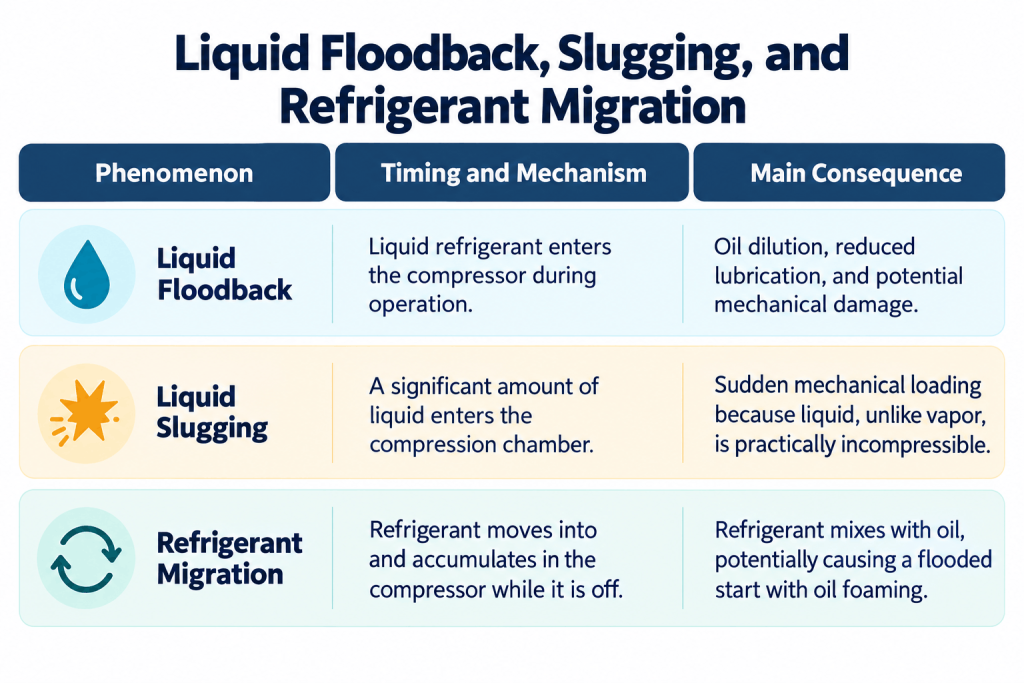
Liquid floodback does not necessarily lead to liquid slugging; it may initially appear as progressive wear caused by inadequate lubrication. Conversely, liquid slugging can also occur during startup because refrigerant has accumulated while the compressor was off.
Why Does Liquid Refrigerant Return to the Compressor?
In direct-expansion systems, the evaporator must provide sufficient opportunity for the refrigerant to evaporate, and refrigerant feed control must match the thermal load. A disturbance in either area can create conditions for liquid floodback.
Reduced Heat Transfer in the Evaporator
Reduced airflow or fluid flow limits the evaporator’s ability to evaporate the refrigerant. Conditions such as a clogged air filter, a dirty coil, fan failure, evaporator icing, or reduced water or coolant flow must be investigated.
For example, if the evaporator fan stops while refrigerant feeding continues, some refrigerant may leave the evaporator without evaporating. Therefore, observing liquid floodback alone does not prove that the expansion valve is defective.
Improper Refrigerant Feeding
An excessively low superheat setting, an incorrectly selected expansion valve, or a temperature-sensing problem can cause the evaporator to receive more refrigerant than it needs. With a thermostatic expansion valve, the sensing bulb’s location and thermal contact are important. With an electronic expansion valve, sensor accuracy and controller settings must also be checked. Danfoss identifies low superheat settings and incorrect bulb installation as factors to investigate when liquid enters the compressor.
Transient Conditions and Low Load
Liquid floodback may occur only during startup, at the end of defrost, following a sudden load change, or when the system changes operating modes. For this reason, measurements taken under steady-state conditions alone are insufficient for a complete assessment. Manufacturers’ guidelines also address performance evaluation under different loads and during defrost.
How Does Liquid Floodback Damage the Compressor?
Reduced Lubrication Quality
Refrigerant entering the oil sump can dissolve in the oil and reduce its viscosity. As a result, the oil film between moving surfaces may no longer provide sufficient load-carrying capacity, increasing the likelihood of bearing wear or failure.
Oil Foaming and Oil Loss During Startup
If refrigerant has accumulated in the oil while the compressor is off, the pressure drop during startup can cause rapid refrigerant evaporation and oil foaming. This condition may carry oil out of the sump and impair lubrication. This mechanism is primarily associated with startup following refrigerant migration and should not be confused with liquid floodback during operation.
Damage Caused by Liquid Slugging
A substantial amount of liquid entering the compression section can create abnormal forces. The type and severity of damage depend on the compressor’s design and the amount of liquid involved. Therefore, a single failure pattern should not be assumed for all compressors.
Are Hermetic and Scroll Compressors Resistant to Liquid Floodback?
A welded compressor shell does not mean that the compressor is immune to liquid floodback. Furthermore, shell construction alone does not determine the suction gas flow path or how the motor is cooled.
Some scroll compressors have a limited ability to tolerate liquid entering the compressor, but this does not permit continuous operation with liquid refrigerant. The manufacturer must specify the permissible limits and protection requirements for each model. For example, Danfoss emphasizes that excessive liquid entering scroll compressors can reduce their service life.
How Is Compressor Superheat Checked?
Compressor inlet superheat is calculated from the difference between the actual suction gas temperature and the saturation temperature corresponding to the suction pressure:
Compressor superheat = Suction line temperature at the measurement point − Saturation temperature corresponding to the pressure at that location
For an accurate measurement:
- Identify the refrigerant precisely.
- Measure pressure and temperature at corresponding locations, following the manufacturer’s instructions.
- Ensure that the temperature sensor makes proper contact with the pipe and that the measurement location is insulated.
- For refrigerant blends with temperature glide, use the saturated vapor temperature, or dew-point temperature, to calculate superheat.
Evaporator outlet superheat is not the same as compressor inlet superheat. Heat gain and pressure drop along the suction line can cause these two values to differ.
Should Superheat Always Be 20°F?
No. 20°F of superheat, equivalent to approximately an 11 K temperature difference, is recommended in the instructions for some Copeland models. However, it cannot be prescribed for every compressor and application. The permissible range must be obtained from the guidelines for the specific model.
Increasing superheat indiscriminately is also not an appropriate solution. Excessive superheat can starve the evaporator and create other performance problems. The objective is to maintain an appropriate, stable value within the manufacturer’s approved range.
A Systematic Approach to Troubleshooting Liquid Floodback
The investigation should begin with system conditions rather than immediately replacing the expansion valve:
- Check evaporator operation: Examine airflow or fluid flow, fan condition, coil contamination, icing, and defrost.
- Record superheat: Measure it at both the evaporator outlet and the compressor inlet under steady-state and transient conditions.
- Check refrigerant feed control: Review valve selection, settings, the sensing bulb, sensors, and the controller.
- Evaluate the refrigerant charge: Follow the manufacturer’s procedure and use the relevant parameters, including subcooling where applicable.
- Check oil behavior and protection devices: Examine the oil level, foaming, crankcase heater, and suction accumulator, where installed.
- Check shutdown and startup conditions: Distinguish possible refrigerant migration from liquid floodback during operation.
Suction line icing, oil foaming, or unusual noise can be warning signs, but none is sufficient on its own for a definitive diagnosis.
What Role Do Protection Devices Play?
A suction accumulator can limit sudden liquid entry into the compressor. However, its selection and operation, including oil return, must be compatible with the system.
A crankcase heater is primarily used to reduce refrigerant accumulation in the oil while the compressor is off. It does not replace corrective action for liquid floodback during operation.
In some systems, a liquid line solenoid valve and a pump-down cycle are also used to limit refrigerant transfer during shutdown. The need for these devices and their implementation must be determined from the manufacturer’s instructions and the system design.
Preventing Repeated Failure
Effective prevention depends on maintaining adequate heat transfer in the evaporator, controlling refrigerant feeding correctly, and checking system performance under all operating conditions. Following compressor failure, the root cause must also be identified, and the condition of the circuit and oil-return devices must be examined for contamination.
For example, a blocked accumulator oil-return passage following a failure can deprive the replacement compressor of oil and cause another failure.
At Radiran, we know Liquid floodback is a system problem. Replacing the compressor without correcting its cause leaves the risk of repeated failure unresolved.
<p>