The Role of Coils in the Refrigeration Cycle: Evaporator and Condenser Coils
Coils are key heat-transfer components in refrigeration, air conditioning, and cold-storage systems. They provide a heat-transfer path between the refrigerant and another fluid, such as air or water. In a conventional vapor-compression refrigeration cycle, the evaporator absorbs heat from the space or fluid being cooled, while the condenser rejects heat to another medium.
A refrigeration system therefore does not “produce cold.” It consumes energy to transfer heat from a lower-temperature region to a higher-temperature region. Proper coil performance, together with the compressor and expansion device, is essential to achieving the required capacity and efficiency.
What Does a Coil Do?
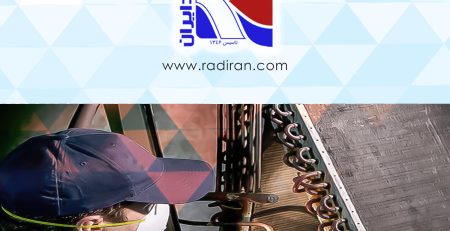
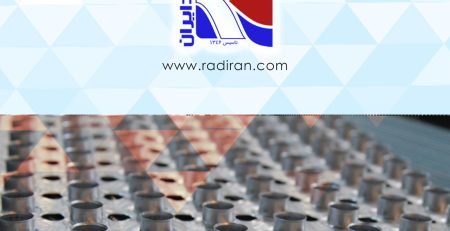
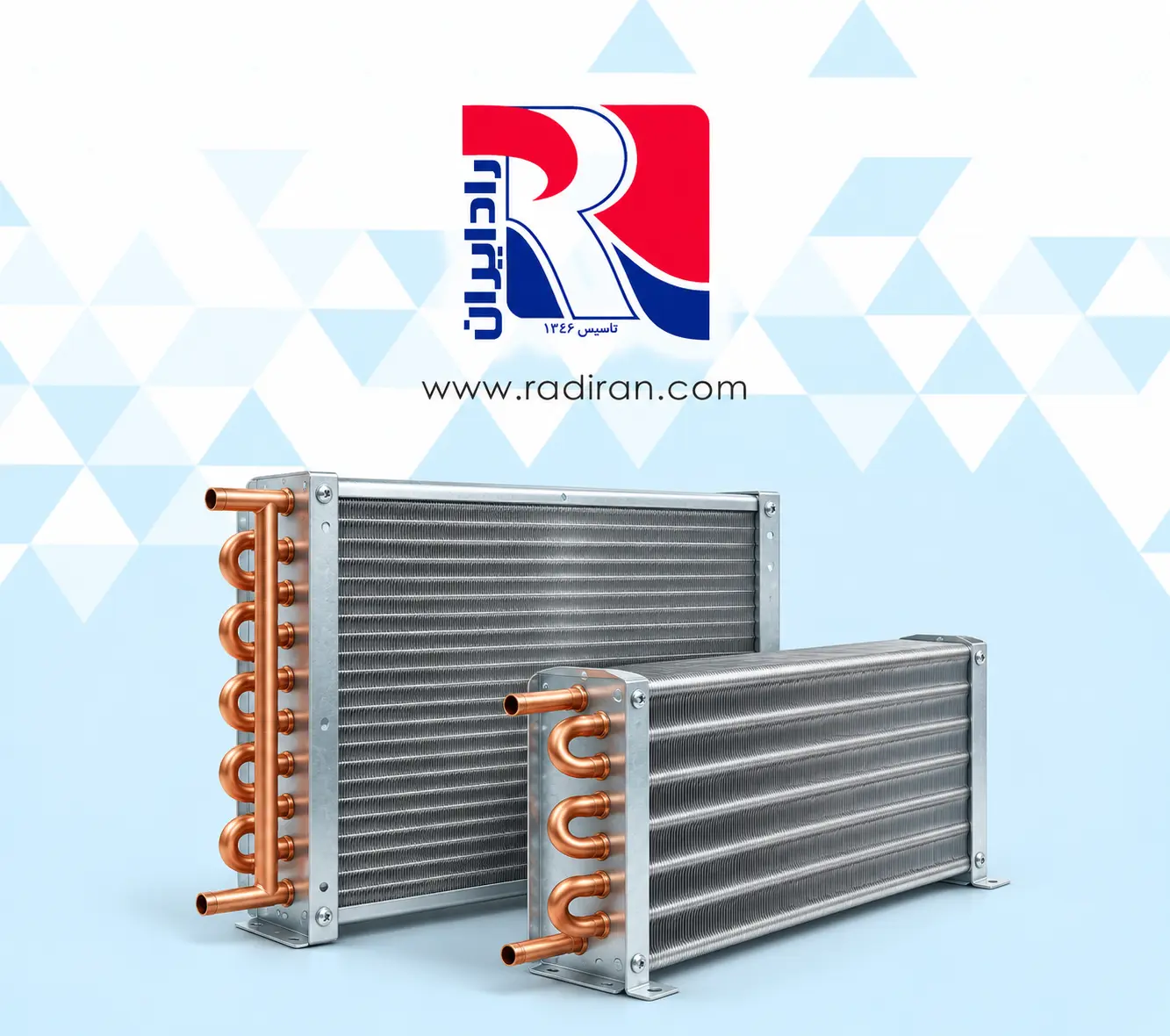
A coil is a type of heat exchanger. In a typical finned-tube coil, fluid flows through the tubes while air passes over the fins. The fins increase the air-side heat-transfer surface area, allowing the required heat exchange to take place within practical equipment dimensions.
A coil’s function depends on its position in the circuit and operating conditions. A refrigerant coil may operate as an evaporator during cooling and as a condenser during heating in a reversible heat pump.
The terms evaporator and condenser therefore describe the coil’s thermal function—not simply whether it is installed indoors or outdoors.
The Evaporator Coil: Absorbing Heat
The evaporator is the heat-absorbing component of the refrigeration cycle. In a direct-expansion system, refrigerant typically enters the evaporator after passing through the expansion device as a low-pressure liquid–vapor mixture.
As heat transfers from the air, water, or process fluid to the refrigerant, the liquid portion evaporates, reducing the temperature of the medium being cooled. In a direct-expansion evaporator, further heat absorption after complete evaporation can superheat the refrigerant vapor.
Typical evaporator applications include:
- Cooling the air inside cold-storage rooms.
- Cooling air in air-conditioning equipment.
- Chilling water or a secondary fluid in chillers.
- Removing heat from products and industrial processes.
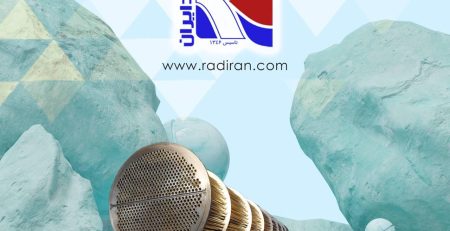
An evaporator is not necessarily an air coil. Depending on the application, it may use another heat-exchanger configuration, such as plate or shell-and-tube construction. Its primary function remains the same: transferring heat from the medium being cooled to the refrigerant.
The Condenser Coil: Rejecting Heat
After compression, refrigerant vapor enters the condenser at high pressure and temperature. The condenser transfers heat from the refrigerant to a cooler medium, such as outdoor air or water.
In a conventional condenser, the superheated vapor is first cooled to its saturation condition. The refrigerant then condenses into liquid. Depending on the design and operating conditions, the liquid may also be subcooled before leaving the condenser.
The condenser heat-rejection load is not equal to the evaporator cooling load alone. Energy added to the refrigerant during compression must also be rejected. For a simplified steady-state cycle:
Condenser heat rejection ≈ Evaporator heat absorption + Compression power transferred to the refrigerant
Consequently, selecting a condenser solely from the evaporator’s cooling capacity is insufficient. Ambient conditions, compressor performance, and any separate heat-rejection paths must also be considered.
Evaporator and Condenser Coil Comparison
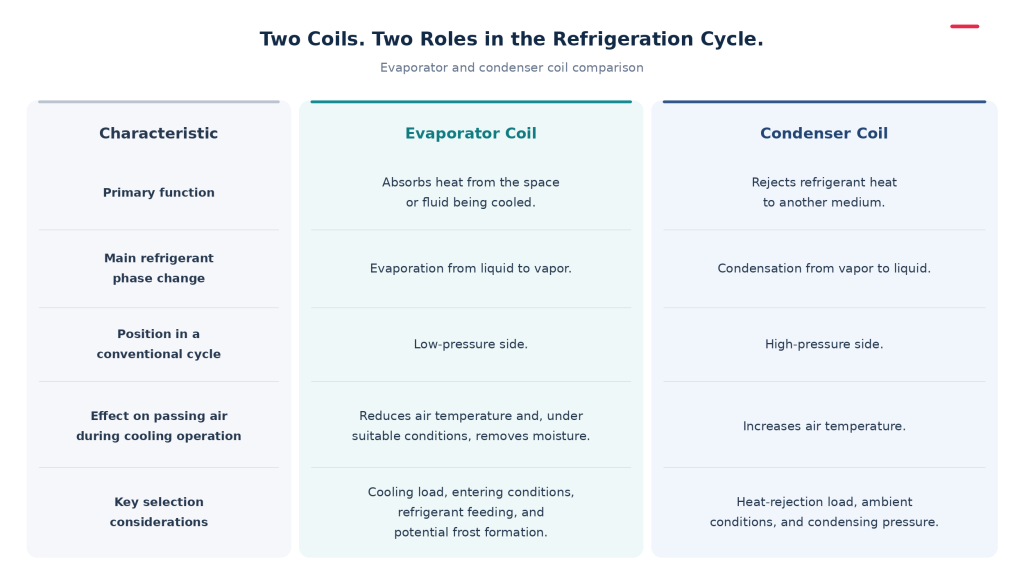
This comparison applies to a conventional vapor-compression cycle in which the refrigerant condenses in the condenser.
Is Every Cooling Coil an Evaporator?
No. A chilled-water coil differs from a refrigerant evaporator coil.
In a direct-expansion (DX) coil, refrigerant evaporates inside the coil and directly absorbs heat from the air.
In a chilled-water coil, water or a water–glycol solution flows through the tubes and absorbs heat from the air. Refrigerant phase change does not normally occur within this coil; the refrigeration circuit’s evaporator is located in the chiller.
Similarly, a hot-water coil heats air using heat supplied by a water circuit. It is not necessarily a refrigeration-system condenser.
Distinguishing between hydronic and refrigerant coils is essential for accurate equipment selection and description.
Why Are Finned-Tube Coils Widely Used?
Increasing heat-transfer surface area is particularly important in air-handling equipment. Finned-tube construction provides a larger effective surface without requiring an excessive increase in equipment size.
The number of tube rows, tube diameter and arrangement, fin spacing, and internal circuiting all affect capacity and pressure drop.
Adding more fins or tube rows does not automatically produce a better selection. The design must deliver the required capacity while meeting pressure-drop limits, installation constraints, and operating requirements.
Coil selection therefore involves balancing capacity, pressure drop, dimensions, and tube and fin specifications.
How Are Coil Materials Selected?
Copper tubes with aluminum fins are a common combination in finned-tube coils. All-aluminum designs and other material combinations are also used.
Material selection should not be based on thermal conductivity alone. Important considerations include:
- Compatibility with the refrigerant or fluid inside the tubes.
- Design pressure and temperature.
- Corrosion exposure at the installation site.
- Cleaning and maintenance conditions.
- Mechanical strength, weight, and manufacturing cost.
A material suitable for one project is not necessarily suitable for every application.
What Information Is Required for Proper Coil Selection?
Specifying capacity alone is insufficient. The required capacity must be defined together with the conditions under which the coil will operate.
- Application: Cooling, heating, cold storage, or an industrial process.
- Fluid type: Refrigerant, water, or a secondary fluid, including its relevant properties.
- Entering and leaving conditions: Temperatures, air humidity where applicable, and fluid conditions.
- Airflow and fluid flow rates: Together with the allowable pressure drop on each side.
- Installation constraints: Dimensions, airflow direction, service access, and connection locations.
- Environmental conditions: Contamination, humidity, corrosion exposure, and potential frost formation.
- Mechanical requirements: Operating pressure, design pressure, and material compatibility.
The coil must also be matched to the other system components. In DX systems, compatibility with the compressor and refrigerant controls is important. For heat pumps, performance must be evaluated in both cooling and heating operation.
Conclusion
At Radiran, we recognize that selecting the right coil requires matching its thermal and mechanical design to the project’s actual operating conditions. The evaporator absorbs heat and the condenser rejects it, but their actual capacities depend on operating conditions, air or fluid flow, and coordination with the rest of the system.
Proper coil selection involves more than choosing copper or aluminum and specifying dimensions. It must satisfy the required capacity, pressure-drop limits, durability, and maintenance needs together.