Evaporator Superheat vs. Compressor Inlet Superheat
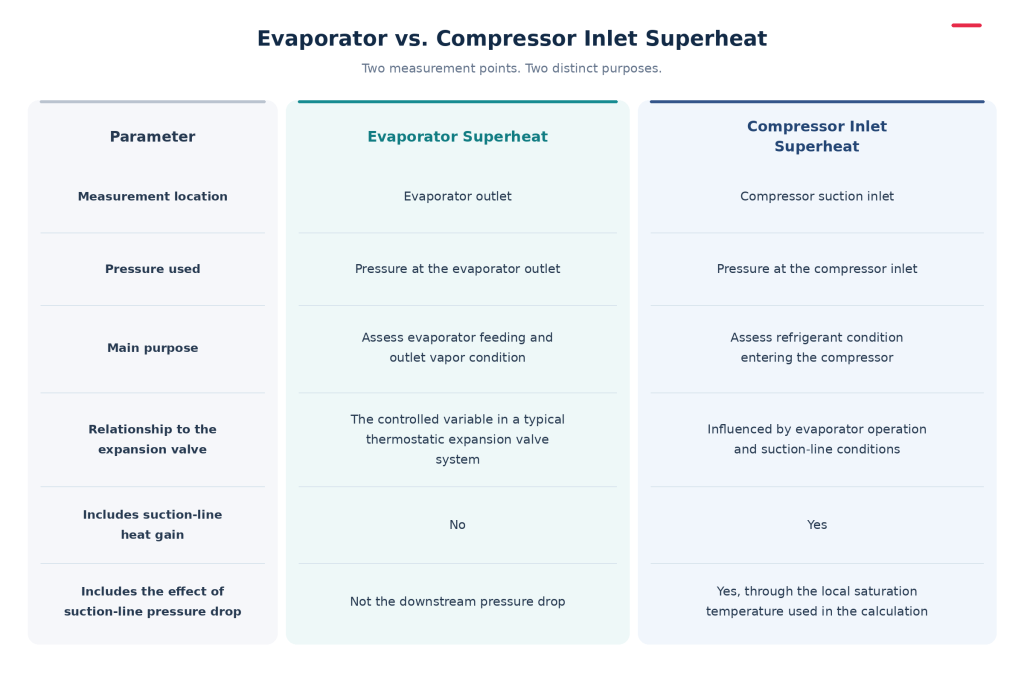
Evaporator superheat and compressor inlet superheat are measured at different locations and serve different purposes. Evaporator superheat helps assess refrigerant feeding and evaporation within the evaporator. Compressor inlet superheat helps evaluate the condition of the refrigerant entering the compressor.
Understanding this distinction is essential when adjusting expansion valves, diagnosing liquid floodback, and assessing refrigeration system performance.
What Is Superheat?
Superheat is the difference between the actual temperature of refrigerant vapor and its saturation temperature at the pressure prevailing at the same location.
Superheat = Actual refrigerant vapor temperature − Saturation temperature at the local pressure
For example, if the refrigerant vapor temperature is 5°C and the saturation temperature corresponding to its pressure is 0°C, the superheat is:
5 − 0 = 5 K
Superheat is a temperature difference. A difference of 5 K is numerically equal to a difference of 5°C. However, Fahrenheit temperature differences require conversion:
20°F of superheat ≈ 11.1 K
For zeotropic refrigerant blends with temperature glide, use the dew-point saturation temperature when calculating vapor superheat.
What Is Evaporator Superheat?
Evaporator superheat is the superheat measured at the evaporator outlet, typically near the sensing bulb of a thermostatic expansion valve.
In a typical direct-expansion evaporator, refrigerant enters as a liquid–vapor mixture. As it absorbs heat, the remaining liquid evaporates. Once evaporation is complete, further heat absorption raises the vapor temperature above its local saturation temperature, producing superheat.
Consequently, describing the entire refrigerant mixture at the evaporator inlet as having “zero superheat” can be misleading. Superheat is used to describe vapor above its saturation temperature; the inlet mixture is normally in the two-phase region.
In a system equipped with a thermostatic expansion valve, the valve regulates refrigerant flow in response to conditions sensed at the evaporator outlet. Its control objective is to maintain appropriate outlet superheat as operating conditions change.
How to Measure Evaporator Superheat
1. Measure the suction-line temperature at the evaporator outlet, close to the sensing bulb.
2. Measure the refrigerant pressure at, or representative of, that same location.
3. Convert the pressure to the appropriate saturation temperature for the refrigerant.
4. Subtract the saturation temperature from the measured line temperature.
Ensure that the temperature probe has good thermal contact with the pipe and is protected from ambient temperature effects.
Using pressure measured near the compressor without accounting for suction-line pressure drop can produce an inaccurate evaporator superheat calculation.
What Is Compressor Inlet Superheat?
Compressor inlet superheat is the superheat measured immediately upstream of the compressor suction connection. It is also commonly called total superheat or system superheat.
After leaving the evaporator, refrigerant travels through the suction line before reaching the compressor. Along this route:
– Heat gain can increase the refrigerant vapor temperature.
– Pressure drop can reduce the corresponding saturation temperature.
– A suction-line heat exchanger, where installed, can add further superheat.
As a result, compressor inlet superheat is often higher than evaporator outlet superheat. The difference depends on piping length, insulation, ambient conditions, refrigerant flow, pressure drop, and system configuration.
How to Measure Compressor Inlet Superheat
Measure the suction-line temperature and refrigerant pressure close to the compressor inlet, then calculate:
Compressor inlet superheat = Suction vapor temperature at the compressor − Saturation temperature at the compressor inlet pressure
The compressor manufacturer’s instructions should determine the exact measurement location and acceptable operating limits.
Comparing the Two Measurements
A Practical Example
Consider the following measurements:
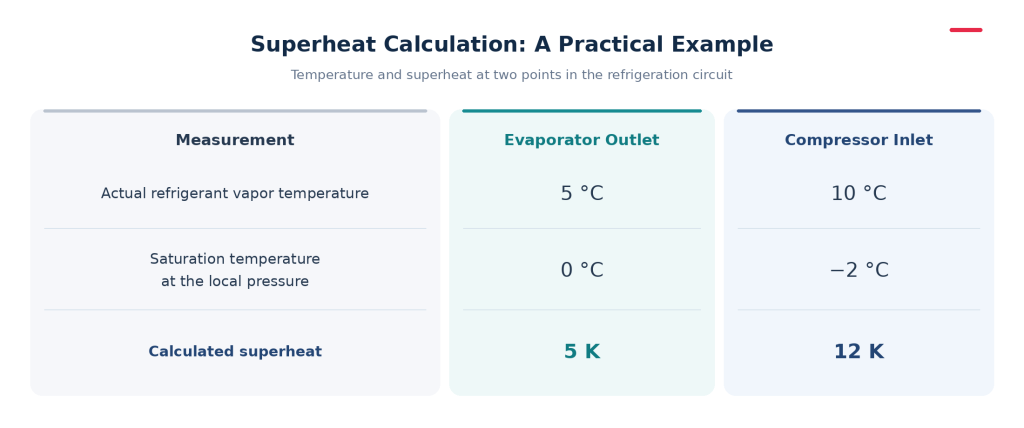
At the evaporator outlet:
Evaporator superheat = 5 − 0 = 5 K
At the compressor inlet:
Compressor inlet superheat = 10 − (−2) = 12 K
The 7 K difference consists of a 5 K increase in actual vapor temperature and a 2 K decrease in saturation temperature caused by pressure drop.
This illustrates why total superheat should not automatically be treated as evaporator superheat plus suction-line temperature rise alone.
Is Return Gas Temperature the Same as Superheat?
No. Return gas temperature is an actual temperature; superheat is a calculated temperature difference.
A thermometer measures the suction vapor temperature, but pressure is also required to determine superheat.
For example, at the same measured vapor temperature of 10°C:
– A local saturation temperature of 0°C gives 10 K of superheat.
– A local saturation temperature of −5°C gives 15 K of superheat.
The measured temperature is identical, but the superheat differs because the pressure differs.
However, this does not mean return gas temperature is physically independent of pressure. Both temperature and pressure can change as system operating conditions change.
How Much Superheat Is Required at the Compressor Inlet
?
There is no single minimum superheat value suitable for every compressor and application.
Some compressor application guidelines specify a minimum suction superheat of approximately 20°F, equivalent to 11.1 K, under defined conditions. This value must not be applied universally.
Acceptable compressor inlet conditions depend on factors such as:
– Compressor design and model.
– Refrigerant and lubricant.
– Evaporating and condensing conditions.
– Compressor operating envelope.
– Motor cooling requirements.
– Maximum return gas and discharge temperatures.
Use the requirements published for the specific compressor and application.
Is Higher Superheat Always Better?
No. Insufficient superheat may indicate a risk of liquid refrigerant reaching the compressor. Excessive superheat can raise suction and discharge temperatures and, depending on the operating conditions, reduce suction vapor density, refrigerating capacity, and efficiency.
High compressor inlet superheat may result from excessive suction-line heat gain even when evaporator superheat is acceptable. Conversely, a high reading at the compressor can conceal excessively low superheat at the evaporator outlet.
A satisfactory steady-state reading also does not guarantee protection against liquid return during startup, defrost recovery, or rapid load changes.
Check Installation Before Adjusting the Expansion Valve
Before changing the valve setting, verify:
– Correct sensing bulb location, attachment, and insulation.
– Correct external equalizer connection, where applicable.
– Adequate airflow or fluid flow through the evaporator.
– Evaporator cleanliness and defrost performance.
– Appropriate refrigerant supply to the expansion valve.
– Accurate temperature and pressure measurements.
– Sufficient time for operation to stabilize.
Adjusting the expansion valve to compensate for an installation fault or an unrelated system problem can make operation less stable.
Conclusion
Evaporator superheat describes the vapor condition leaving the evaporator. Compressor inlet superheat describes the vapor condition entering the compressor. Suction-line heat gain and pressure drop can create a substantial difference between these measurements.
At Radiran, we emphasize measuring temperature and pressure at corresponding locations and evaluating both readings against the equipment manufacturer’s requirements. This approach supports accurate diagnosis, stable evaporator operation, and reliable compressor performance.