Liquid Refrigerant Floodback: Causes, Symptoms, and Prevention
Liquid refrigerant floodback occurs when some of the refrigerant entering a running compressor is still in the liquid phase. In systems designed to supply refrigerant vapor to the compressor, this condition can dilute the lubricant, impair lubrication, and, in severe cases, damage mechanical components.
The problem often begins when refrigerant does not evaporate completely in the evaporator. However, identifying the root cause requires examining refrigerant feeding, heat transfer, superheat control, and transient operating conditions together. Adjusting or replacing the expansion valve without these checks may fail to resolve the problem.
Floodback, Liquid Slugging, and Refrigerant Migration
These terms describe related but distinct phenomena:
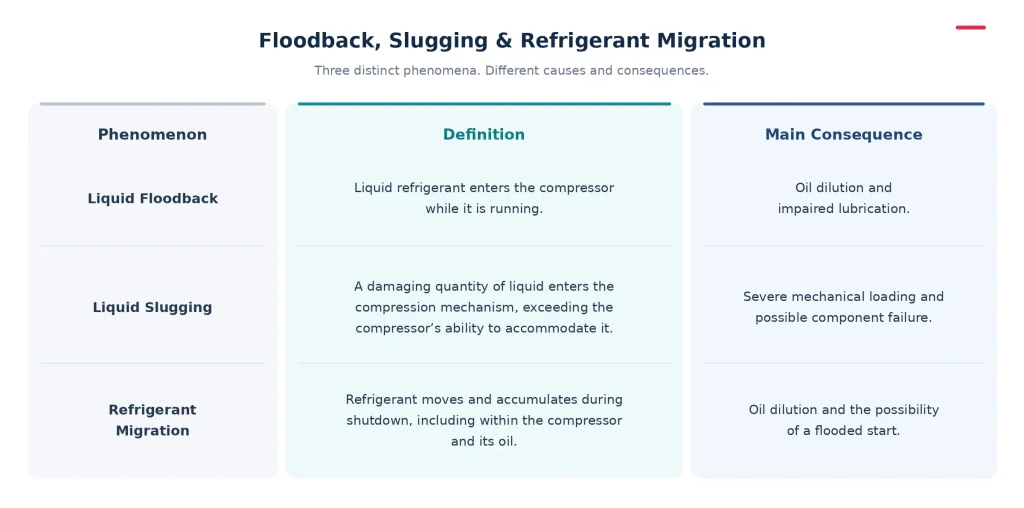
Floodback does not necessarily result in liquid slugging. Damage may develop gradually as lubrication deteriorates. Refrigerant migration generally occurs during shutdown and must be distinguished from liquid returning to the compressor during operation.
Why Does Liquid Refrigerant Return to the Compressor?
In a direct-expansion evaporator, refrigerant supply must remain matched to the available heat load. If refrigerant feeding exceeds the rate of evaporation, or heat transfer decreases, some liquid may leave the evaporator and enter the suction line.
1. Incorrect Expansion Valve Selection or Control
The expansion valve must be selected for the refrigerant, required capacity, and operating range. An unsuitable valve, an excessively low superheat setting, or unstable valve operation can disrupt evaporator feeding.
A high nominal valve capacity alone does not establish the diagnosis. The valve’s controllable capacity range, minimum evaporator load, and actual operating conditions must also be evaluated.
A thermostatic expansion valve regulates evaporator outlet superheat. Any adjustment should therefore be based on an accurate measurement at that location.
2. Incorrect Sensing Bulb Installation
A loose sensing bulb, poor thermal contact with the suction line, or exposure to ambient temperature can cause the valve to respond to a temperature that does not accurately represent the refrigerant leaving the evaporator. Refrigerant flow may then become mismatched to the evaporator’s requirements.
Check the bulb location, mounting clamp, insulation, and external equalizer arrangement against the manufacturer’s instructions. Bulb attachment and airflow distribution across the coil are also important checks when investigating unstable valve operation.
3. Insufficient Evaporator Airflow or Heat Transfer
Reduced heat transfer lowers the evaporator’s ability to vaporize refrigerant. Common causes include:
– Dirty air filters or coil surfaces.
– Fan failure or reduced fan speed.
– Restricted airflow.
– Excessive frost or ice accumulation.
– Incorrect or ineffective defrost operation.
These conditions can contribute to floodback, particularly when the refrigerant feed control does not respond quickly enough.
4. Incorrect Refrigerant Charge
An excessive refrigerant charge can contribute to liquid management problems. However, its relationship to floodback depends on the circuit design and expansion device. A capillary tube or fixed-orifice system does not necessarily respond to charge changes in the same way as a system equipped with an expansion valve and liquid receiver.
A cold suction line or visible frost is not sufficient evidence of overcharging. Evaluate the refrigerant charge using the equipment manufacturer’s specified procedure.
5. Transient Operation and Load Changes
Floodback may be intermittent rather than continuous. It can occur during capacity changes, substantial load reductions, or conditions associated with defrost.
A satisfactory reading during steady operation therefore does not confirm acceptable performance under every operating condition. Evaluation should include the unfavorable transient conditions identified by the equipment manufacturer.
How Does Floodback Damage a Compressor?
Liquid refrigerant can dilute the compressor oil and reduce its ability to maintain an adequate lubricating film. Continued operation under these conditions increases the risk of wear in bearings and other moving components.
In severe cases, liquid entering the compression mechanism can also cause mechanical damage.
The type and location of damage depend on compressor design and on the severity and duration of liquid return. The limited tolerance of some compressors to occasional liquid ingestion does not make continuous floodback acceptable.
How Should Floodback Be Investigated?
Measure Superheat at the Correct Location
To evaluate the refrigerant vapor entering the compressor, calculate:
Compressor inlet superheat = Actual suction vapor temperature − Saturation temperature corresponding to the pressure at the same location
Temperature and pressure must represent the same measurement location. Using pressure measured near the compressor to calculate evaporator outlet superheat, without accounting for suction-line pressure drop, can produce a misleading result.
There is no universal minimum superheat for every compressor. For example, certain Copeland application guidelines specify a minimum of 20°F of superheat, equivalent to approximately 11.1 K, for particular models and operating conditions. This value must not be applied to all equipment.
Evaluate Oil Condition and Operating Conditions
For some compressors, the manufacturer also specifies oil temperature criteria or oil dilution limits when assessing floodback risk. Suction-line superheat is therefore not always the sole acceptance criterion.
Visual observations—including a cold compressor shell, frost formation, or changes in oil behavior—must be interpreted alongside measured operating data. None of these observations independently establishes the cause of a failure.
A Systematic Approach to Correcting Floodback
Corrective action should address the underlying cause.
1. Check Evaporator Heat Transfer
Inspect coil cleanliness, airflow, fan operation, and defrost performance.
2. Verify Sensing Components
Check the sensing bulb’s location, thermal contact, insulation, and associated connections.
3. Evaluate Refrigerant Feeding
Confirm expansion valve selection, operation, and adjustment, and verify the refrigerant charge.
4. Record Transient Conditions
Monitor operation during load changes, capacity changes, and relevant stages of the defrost sequence.
5. Review the Required Protective Measures
In susceptible systems, a suction accumulator can retain liquid refrigerant upstream of the compressor. Its selection and application must follow the manufacturer’s requirements.
Installing an accumulator does not correct the underlying cause of excessive refrigerant feeding or inadequate evaporator heat transfer.
A crankcase heater primarily helps control refrigerant migration during shutdown. It should not be treated as a solution to continuous liquid floodback while the compressor is running.
Conclusion
At Radiran, we recognize that liquid floodback indicates a system operating problem and should not automatically be attributed to a faulty expansion valve. Examining evaporator heat transfer, refrigerant feed control, local superheat, and transient operation provides a more reliable path to identifying the root cause.
The objective is to maintain the compressor inlet conditions and lubrication requirements specified by the manufacturer—not to increase superheat indiscriminately.