What Is Refrigeration System Evacuation? Purpose, Equipment, and Proper Verification
Refrigeration system evacuation is the process of reducing the pressure inside a refrigerant circuit using a vacuum pump to remove air, non-condensable gases, and moisture. It is normally performed before charging refrigerant during initial installation or after repairs that have exposed the circuit to the atmosphere.
Evacuation quality cannot be assessed solely by how long the pump runs. Final system pressure, pressure behavior after isolating the pump, equipment temperature, and the extent of contamination all influence the result.
Why Must a Refrigeration System Be Evacuated?
Removing Air and Non-Condensable Gases
Gases such as air do not condense like the refrigerant under normal condenser operating conditions. Their presence can increase high-side pressure and impair heat transfer in the condenser.
Higher condensing pressure increases compressor workload and energy consumption and may raise discharge temperature. Describing the problem simply as “air collecting at the top of the condenser” is therefore incomplete. The main issue is the presence of non-condensable gases and their effects on pressure and heat transfer.
Reducing Moisture in the Circuit
Moisture can freeze at cold locations, including expansion valve passages or capillary tubes, restricting refrigerant flow. Depending on the refrigerant, lubricant, and operating temperatures, moisture can also increase the risk of acid formation, corrosion, and deterioration of the lubricant and electrical insulation.
The consequences may include unstable operation, blocked passages, or mechanical and electrical compressor damage.
Does a Vacuum Pump Remove Liquid Water Directly?
A vacuum pump is not intended to drain substantial quantities of liquid water. During vacuum dehydration, reducing the pressure allows water to evaporate at a lower temperature, after which the resulting vapor is removed from the circuit.
However, moisture removal is not always quick or straightforward. Evaporation consumes heat and can cool the remaining water. Under unfavorable conditions, some of that water may freeze, making dehydration more difficult.
If a significant amount of water has entered the circuit, evacuation alone is insufficient. The cause of water ingress must first be corrected, and the condition of the lubricant, filter-drier, and components must then be assessed according to the manufacturer’s instructions. Low ambient temperatures and moisture absorbed in the lubricant can also prolong the process.
What Does “Micron” Mean in Vacuum Measurement?
In evacuation work, “micron” means a
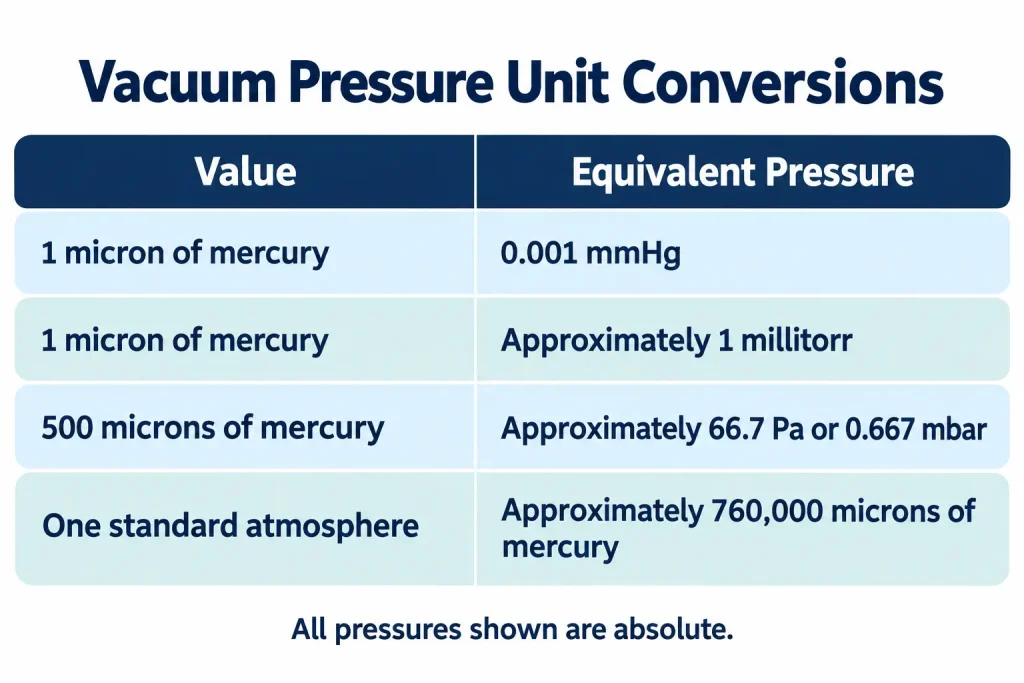
micron of mercury, a unit used to express absolute pressure. It does not describe the size of particles that the pump can remove.
The lower the micron reading, the lower the absolute pressure and the deeper the vacuum.
Therefore, the statement “the pump removes 20-micron particles” is incorrect. If a pump specification states an ultimate pressure of 20 microns, that value describes the pressure attainable under the pump’s specified test conditions. It does not indicate particle size or guarantee that the entire connected system will reach that pressure.
Why Is a Standard Manifold Gauge Insufficient?
A manifold compound gauge is not suitable for accurately measuring very low absolute pressures. A needle approaching 30 inches of mercury vacuum does not, by itself, verify evacuation quality.
A suitable electronic vacuum gauge, commonly called a micron gauge, is required to assess deep vacuum. It measures absolute pressure and allows pressure changes to be monitored after the pump has been isolated.
What Vacuum Level Should Be Achieved?
For many conventional refrigeration and air-conditioning systems, 500 microns or lower is a commonly specified evacuation target. However, the final pressure, standing vacuum test duration, and allowable pressure rise must be obtained from the instructions for the specific equipment.
Momentarily reaching 250 or 500 microns while the pump remains connected is not sufficient on its own. Pressure near the pump may be low while another part of the circuit has not yet reached the same level.
Furthermore, a low reading alone does not prove that residual moisture has been reduced to an acceptable level, particularly if frozen water or moisture absorbed in the lubricant remains present.
Where Should the Micron Gauge Be Installed?
Install the micron gauge directly on the system, preferably away from the pump connection, so that it measures system pressure.
Mounting the gauge immediately next to the pump inlet may produce an overly favorable reading. Restrictions in hoses, fittings, and service connections can create a pressure difference between the pump and the circuit.
During the standing vacuum test, the pump must be isolated while the gauge remains connected to the system.
What Equipment Helps Improve Evacuation?
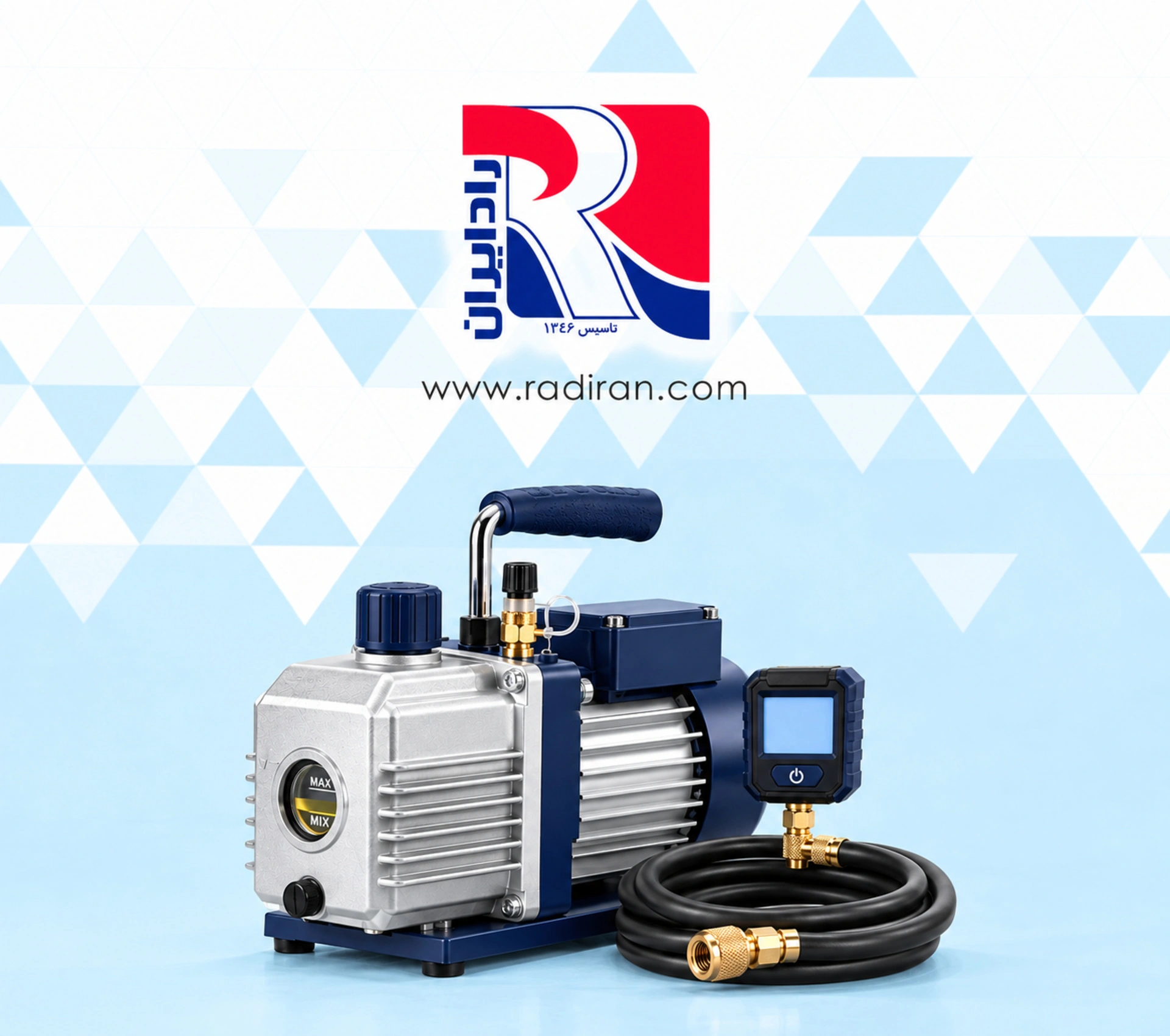
- An appropriate vacuum pump: Both pumping capacity and ultimate pressure capability are important.
- Vacuum-rated hoses: Shorter hoses with larger internal diameters reduce flow restrictions.
- Leak-tight connections: Leaks in hoses or evacuation equipment can be mistaken for system leaks.
- Valve core removal tools: Where permitted, temporarily removing Schrader valve cores with suitable tools reduces restrictions.
- Access to all relevant sections of the circuit: Valve and control component positions must allow every section requiring evacuation to communicate with the pump.
A larger pump cannot fully compensate for severely restricted hoses or fittings. Many manufacturers also recommend connecting to both the high-pressure and low-pressure sides to achieve faster, more uniform evacuation.
How Is a Standing Vacuum Test Performed?
Once the target pressure has been reached:
- Close a suitable isolation valve between the pump and the system. The micron gauge must remain on the system side of the valve.
- Record the pressure and the test start time.
- Monitor the pressure for the period specified by the manufacturer.
- Compare the result with the allowable pressure rise for that equipment.
The test duration and acceptable pressure limit must be specified together. Reporting that “pressure rose to 500 microns” without stating the initial pressure and test duration does not provide enough information to assess the result.
What Does a Pressure Rise Indicate?
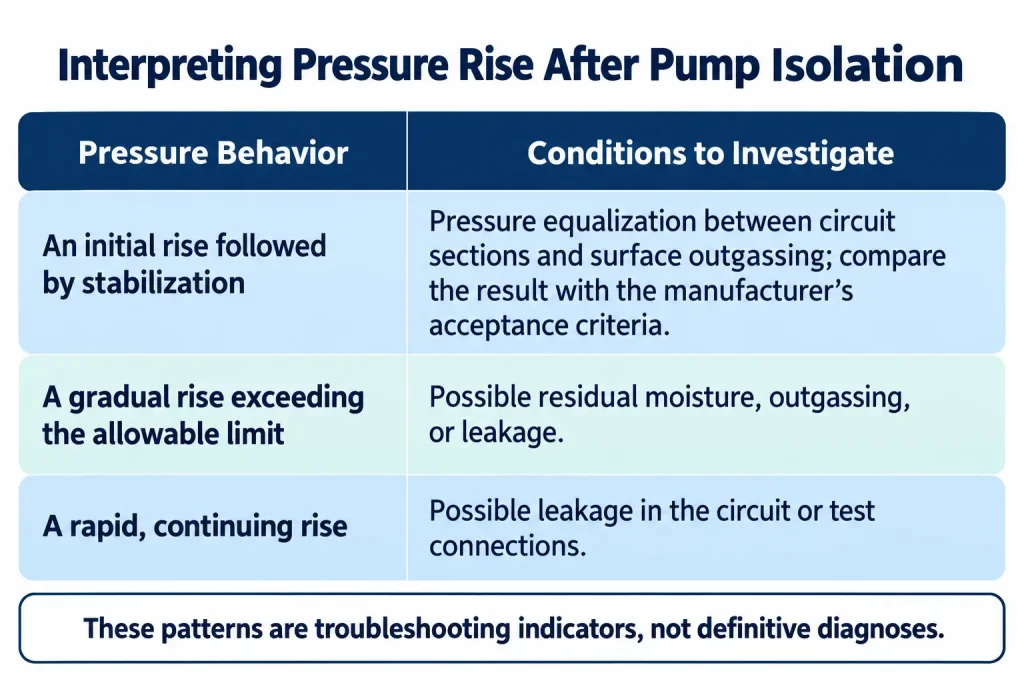
These patterns are troubleshooting indicators, not definitive diagnoses. Pressure-rise behavior alone does not always distinguish leakage from residual moisture.
A standing vacuum test also does not replace a positive-pressure leak test. A connection or seal may behave differently under vacuum than under operating pressure.
When Is Multiple Evacuation Useful?
For moisture-contaminated circuits, or where required by the manufacturer, evacuation may be performed in stages, breaking the vacuum with dry nitrogen between stages.
The circuit is evacuated, dry nitrogen is introduced under controlled conditions, and the evacuation process is repeated. The pressures and number of stages must follow the equipment manufacturer’s procedure.
Nitrogen does not chemically absorb moisture. Its role in this process is to help displace and carry water vapor out of the circuit. Do not use ambient air or oxygen to break the vacuum.
Why Does Vacuum Pump Oil Condition Matter?
In addition to lubrication, vacuum pump oil provides internal sealing. Moisture absorption and contamination can reduce the pump’s ability to achieve low pressure.
If pump performance deteriorates, check:
- Oil level, oil type, and oil condition.
- Hoses and connections for leakage.
- Micron gauge sensor cleanliness.
- Gas ballast position, following the pump instructions.
- Pump performance in an inlet blank-off test.
Use the vacuum pump oil specified by the manufacturer. Oil-change timing and procedures—including whether oil may be changed while warm or while the pump is running—depend on the pump design and must not be assumed to be the same for every model.
General Procedure Before Refrigerant Charging
- If the circuit contains refrigerant, recover it using suitable recovery equipment. A vacuum pump is not a refrigerant recovery machine.
- Complete the repairs and contamination-control measures.
- Perform a leak test using the manufacturer’s approved method and test pressure.
- After safely releasing the test gas under controlled conditions, connect the evacuation equipment and micron gauge.
- Evacuate the circuit to the specified acceptance criteria.
- Perform the standing vacuum test and record the result.
- Once the result is acceptable, begin refrigerant charging according to the manufacturer’s procedure.
Never use the compressor to evacuate the circuit, and never run it under vacuum. Applying power to the compressor motor or performing an insulation-resistance test with a megohmmeter while it is under vacuum can also cause damage.
At Radiran, we know, Proper evacuation is verified when the entire section of the circuit being evacuated has reached the target pressure and passes the standing vacuum test after pump isolation, according to the manufacturer’s criteria. Recording the final pressure, test duration, and pressure-rise result provides a more reliable basis for commissioning and future service assessments.